

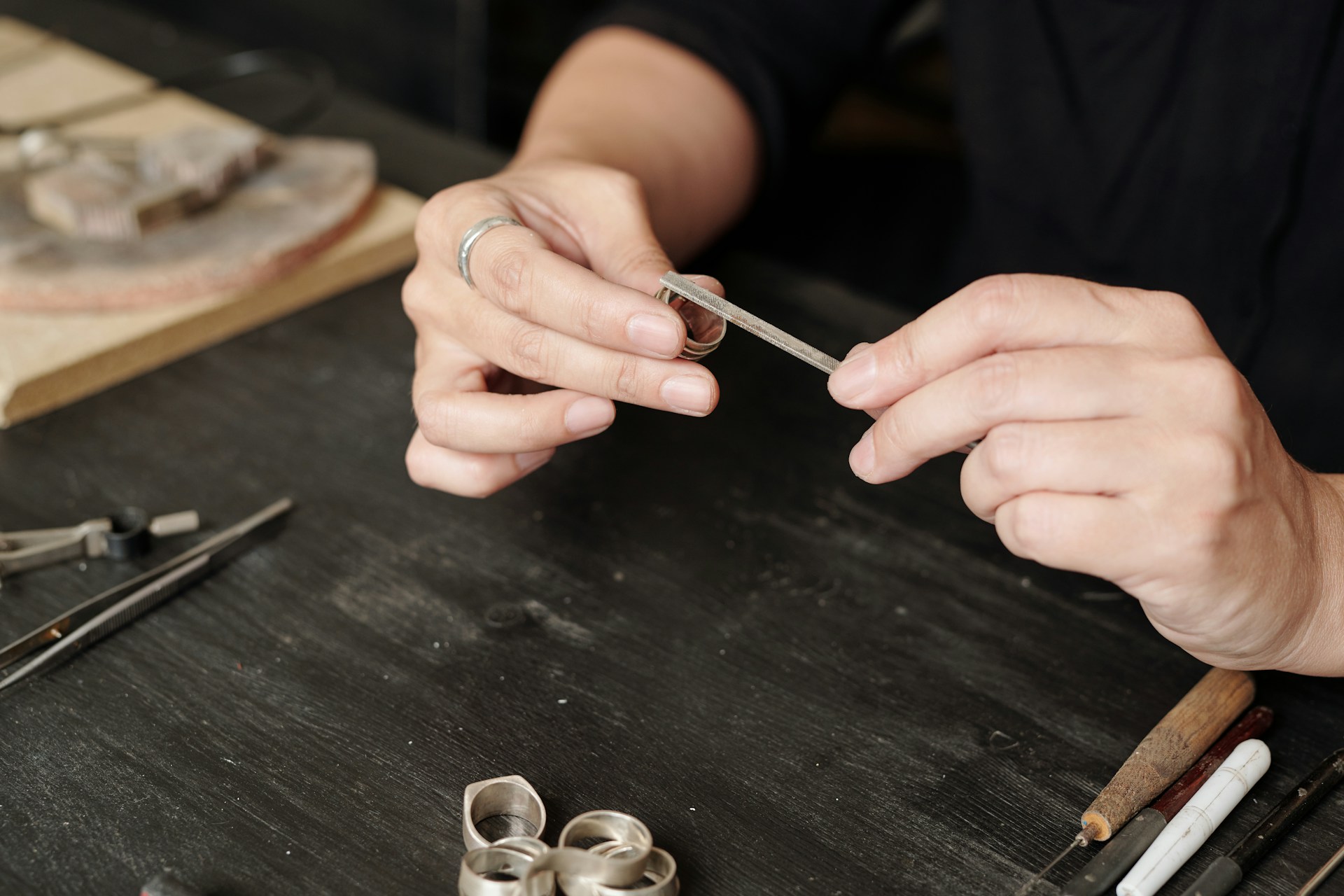
A jeweler apprenticeship can feel like a big unknown up front, especially if you’re just beginning to picture yourself working at the bench in a fine studio. In Alberta, it’s one of the trades that still teaches mostly by doing. That means time at the bench, time with the tools, and time working beside someone more experienced. For people who like working with their hands and want to be part of something that’s both steady and creative, it’s worth learning how this process really works.
Most people don’t know what takes place inside a jewelry studio until they step into one themselves. The hours are quiet, the pace is slow and careful, and every project teaches something if you’re paying attention. A jeweler apprenticeship doesn’t just offer a set of skills. It gives structure to hands-on work and connects you to a way of making things that still depends on human touch.
What Apprentices Learn First
In the first weeks and months, the work is quiet and simple. You learn how to handle the studio tools safely, how to sit properly at a bench, and how to set up for a full day of work. These early lessons might sound small, but if you skip them, the rest doesn’t come together smoothly. Respect for your materials and workspace is something you carry forward for years.
Most apprentices begin with basic hand skills. These include:
• Filing edges and shapes with precision
• Polishing metals to a consistent finish
• Practicing clean, steady solder joints
You’re not making finished pieces just yet. Instead, you’re repeating shapes, watching how the older hands do it, and slowly picking up the rhythm. There’s value in doing the same task many times. That repetition builds control, and control is what lets you create something durable.
We usually find that people settle in once they stop rushing the work. Confidence grows through quiet, steady practice. Mistakes are part of the learning, and they teach just as much as the successes.
Going Beyond the Basics
Once the basic handwork starts to feel more natural, the days begin to change. Apprentices move into more detailed tasks like building settings or shaping metal by hand. Some weeks you’re carving wax models for casting. Others, you’re trying your hand at stone setting under supervision.
At this stage, you’re not just copying shapes. You’re learning how the shapes feel, how they respond to heat or pressure, and how small changes affect the end result. Bench work during this phase is closely watched. You’re offered corrections, but not in a rough way. It’s more about asking questions like, “Why did that happen?” or “How did it feel when you did that?”
This is where technical ability and creative thinking start to connect a bit more. You might look at a ring or pendant and begin to recognize how it went together. You’re no longer just replicating, you’re reacting to the work in front of you and guessing what’s coming next. That level of attention is what keeps pieces crafted by hand feeling personal and grounded.
Real Studio Life During Late Winter in Alberta
February in Alberta tends to call for focus. The weather keeps most of us inside, and workdays rarely feel rushed. Apprenticeship during this time of year often means quiet, steady hours at the bench. That slower rhythm can be useful if you’re building skills that ask for patience.
In colder weeks, a typical day might start a little later and run consistently through the afternoon. Gloves off, apron on, low music in the background. It’s warm in the shop, and the cold outside doesn’t affect much except maybe the pace of movement. You find yourself settling into longer tasks, polishing takes more time, and small-step fabrication work helps fill the hours.
These winter days are helpful for developing attention. There’s not as much rush as the end of year, and it’s too early for spring orders. That gives you space to practice without pressure. Building patience is important, and the end of winter is a good time for it.
Mentorship and Long-Term Growth
What shapes an apprenticeship the most isn’t just the work, it’s the right person teaching beside you. A good mentor doesn’t just point out what went wrong. They explain how it could have gone better, and why it matters.
We’ve seen how learning builds in little moments. Someone notices how a file was held too flat, or how the torch heated a piece too quickly. Those tips stick over time. You start seeing faster improvement through slower, more careful work.
Mentorship isn’t always formal. Sometimes it’s just a passing comment between tasks. Other times, it’s a longer talk at the end of the week. Either way, feedback lands better when it happens during the work, not after.
As apprentices grow more confident, they take on small design choices. Maybe they get to shape a simple band or rebuild a setting to better fit a stone. That step toward design shows that they’re growing from help, not just following directions.
Skills That Last Beyond the Apprenticeship
What you carry with you after training doesn’t just come down to one technique or one project. Most graduates leave with a set of small habits that shape how they work over the long term.
Some of the strongest skills we see include:
• Clear visual planning before starting a piece
• Focused attention on tiny details
• Being able to fix problems without panic
Jewelry-making teaches patience. You learn how to step back, breathe, and work through something again. These habits show up in custom projects, where things change quickly. They also help when speaking with clients, especially if the piece was challenging to build or repair.
There’s no proper end point to this kind of learning. Even after apprenticeship, most people keep improving for years. They just trade supervision for self-trust.
A Look at What the Work Builds Toward
A jeweler apprenticeship gives structure to learning that would be hard to pick up alone. It’s a path shaped by people, by tools, and by repetition. It gives your hands something to do while your mind catches up. It brings order to pieces of metal and design ideas that could easily become tangled without guidance.
More than that, it helps you build a steady hand, a clear eye, and a pace you can hold for decades. That’s the real value. You end up with something you can carry with you, into your own work, your studio, or wherever your skills take you next.
Starting your journey in a craft that requires patience, focus, and a steady hand is best done with a strong foundation, and a proper jeweler apprenticeship can set you up for long-term success. At Daniel Sommerfeld Jewelry, we value hands-on learning and believe that taking the time to develop real skills makes all the difference. Whether your path leads you to a career at the workbench or opens doors to design, our team in Alberta is here to discuss how an apprenticeship can help you grow. Reach out to us to explore your next steps.